
Proof that your hearing aids are set right.
Most hearing aids are programmed using average assumptions that don't account for the unique shape and size of your ear canal. Real Ear Measurement is the evidence-based standard that changes that: it measures the actual sound reaching your eardrum with your hearing aid in place, so Dr. Kun can verify and fine-tune your fitting with precision rather than guesswork.

- Step 1
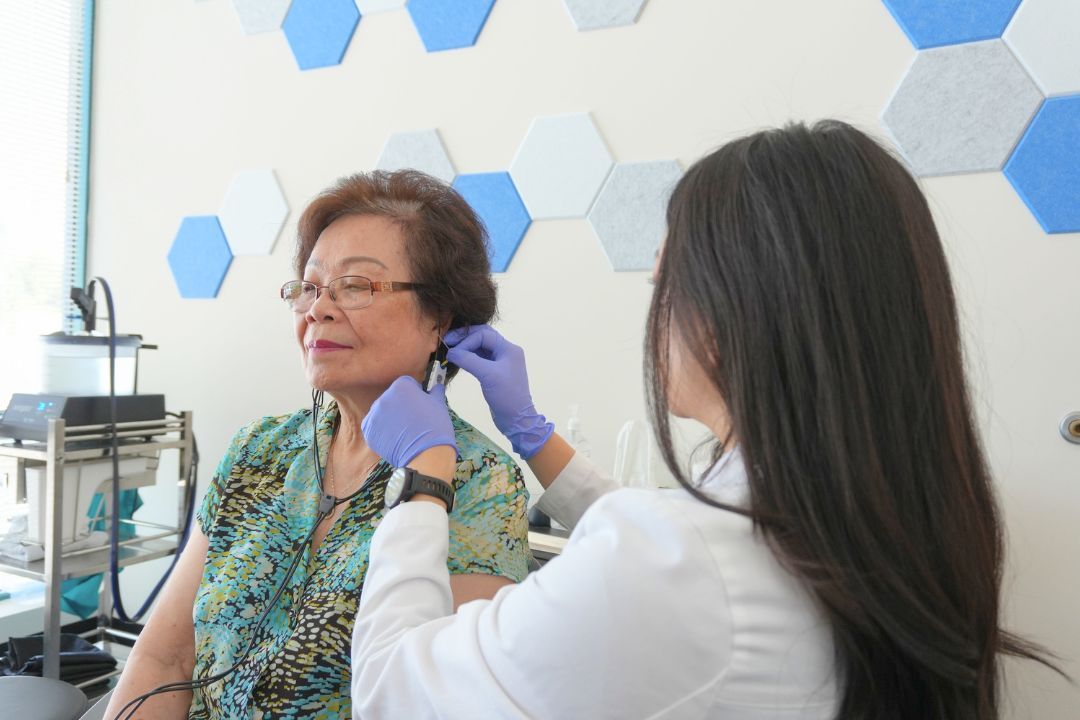
Probe placement & preparation
A thin, flexible probe microphone is placed in your ear canal alongside your hearing aid. Ears can be sensitive to the probe, so most patients feel a light tickle and for some it can be briefly uncomfortable, but it only takes a moment to position. Dr. Kun walks you through what the measurements show and what you'll see on screen before anything begins.
- Step 2
Measuring with your hearing aid
With the probe in place alongside your hearing aid, the measurement captures exactly how much sound is reaching your eardrum with amplification active. This is the reading that many fittings elsewhere skip, and it's the most important one.
Real-time results displayed - Step 3
Comparing to targets & fine-tuning
Dr. Kun compares your aided measurements against prescriptive targets set by your audiogram. If the output is off, she adjusts your hearing aids in real time and re-verifies until your fitting matches what your hearing actually needs.
Electroacoustic Analysis completed beforehand
Every adjustment made to a number, not a feeling.
Dr. Kun shows you the measurements as they happen, so you can see exactly what your hearing aids are doing before you leave.
Your ear canal is one of a kind. Your fitting should reflect that.
Without Real Ear Measurement, hearing aids are programmed based on manufacturer averages that assume a standard ear canal shape, size, and volume. In practice, ear canals vary significantly from person to person, which means two people with the same audiogram and the same hearing aid can end up with very different results at the eardrum.
Studies show that fewer than half of hearing aid providers use Real Ear Measurement as part of their standard fitting process (Mueller HG, Picou EM. Survey examines popularity of real-ear probe-microphone measures. Hear Jour. 2010;63(5):27-32).
Frequently asked questions
Still have questions? Call us at (626) 820-9116 or send a message, and we reply the same day.
Real Ear Measurement uses a tiny probe microphone placed in your ear canal to measure the actual sound level reaching your eardrum with your hearing aid in place. It matters because hearing aids programmed without it are based on averages that may not match your specific ear, which can result in a fitting that's too loud, too soft, or uneven across frequencies.
REM requires specialized equipment, training, and additional appointment time. Some providers skip it in favor of faster fittings, relying on manufacturer software alone. At Kun Hearing, REM is a standard part of every fitting because research consistently shows it leads to better outcomes and more satisfied patients.
Yes. If your hearing aids were fitted without Real Ear Measurement, Dr. Kun can use REM to verify and adjust your current programming. It's a worthwhile step if you've felt your hearing aids were never quite right.
REM is built into the fitting appointment and doesn't require a separate visit. The measurement itself typically takes about 5 to 15 minutes, closer to 15 if acoustic changes to the device are needed. Fitting appointments overall typically run 60 to 90 minutes.
Electroacoustic Analysis (EAA) checks the physical performance of the hearing aid itself, measuring its output, frequency response, and distortion independent of your ear. We perform EAA before your fitting appointment. Together with REM, it gives a complete picture: EAA confirms the device is functioning correctly, and REM confirms it's programmed correctly for your specific ear.
Coverage depends on your plan. REM is a standard part of your fitting at Kun Hearing, but whether it's separately covered or billable varies by plan and by whether you're seen as a direct-insurance, third-party, or private-pay patient. We're glad to review your coverage with you before your appointment so there are no surprises.